
The short answer
The real question about AI isn't whether it will replace your business — it's which parts it can do. For almost every local business, that's the busywork, not the business. Score yourself on six yes/no questions: does the work need physical presence, a license, your personal reputation, a community, proprietary data, or sell an outcome? Two or more yeses means your core is safe and the opportunity is to let AI handle the repetitive work.
The Short Answer
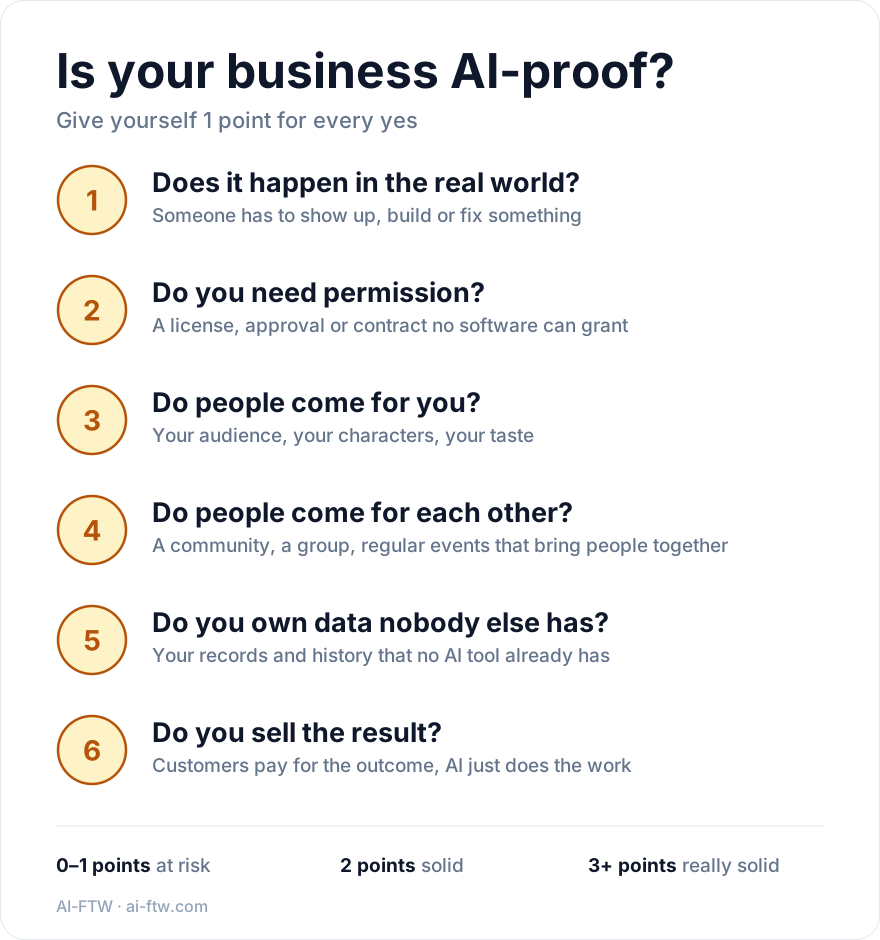
Most local business owners are asking the wrong question about AI. It isn't "will a robot replace me?" — it's "which parts of my business can software actually do?" The honest answer, for almost every local business we talk to, is: the busywork, not the business. The six questions below show you why. Give yourself one point for every yes. Two or more and your core is safe; the real opportunity is handing the repetitive work to AI so you can do more of what only you can do.
How to Use This
Read each question and answer yes or no about your own business. One point per yes. Takes about two minutes. The score at the end isn't a grade — it's a map of what to protect and what to automate.
The Six Questions
1. Does it happen in the real world?
Does someone physically have to show up, build something, or fix something? A plumber, a dentist, a caterer, a contractor, a hair stylist — these all happen in the real world. Software can book the appointment and send the reminder, but it can't unclog the drain. If your work means someone has to be there in person, that part is yours.
2. Do you need permission?
Does your work require a license, a certification, an approval, or a signed contract that a computer can't grant? A CPA signs tax returns. A licensed contractor pulls permits. A medical practice carries credentials. That kind of official trust protects you — no software can hand it out.
3. Do people come for you?
Do customers choose you for your judgment, your taste, your reputation, your face? The regulars who come back because they trust you specifically aren't choosing a service they could get from an app. Relationships and reputation don't transfer to a model.
4. Do people come for each other?
Is there a community, a group, or a regular event where your customers show up partly for the other people? A yoga studio, a neighborhood gym, a local market — the room full of people is the real draw. AI can't be the room.
5. Do you own data nobody else has?
Do you hold information a general AI model will never see — your customer history, your pricing, what actually sells in your neighborhood, the notes from ten years of jobs? That private data is exactly what makes a smartly-built tool smarter than ChatGPT for your business. It's an asset most owners don't realize they're sitting on.
6. Do you sell the result?
Do customers pay you for an outcome — a clean house, a working website, a filed return, a treated patient — rather than for the typing in between? If they're buying the result, then AI doing the busywork faster doesn't threaten you. It just lowers your cost of delivering it.
Your Score
- 0–1 points — at risk. A large share of what you sell is work software can now do. That doesn't mean "give up" — it means the smart move is to add something AI can't copy: a relationship, a physical service, proprietary data, a community. Worth a serious conversation.
- 2 points — solid. Your core is defensible. The opportunity now is to automate the repetitive parts so you spend more time on the two things that scored.
- 3+ points — really solid. AI is leverage for you, not a threat. Every piece of busywork you hand to software is time back for the parts of the business only you can do.
What a High Score Actually Unlocks
Here's the part most owners miss. A high score doesn't mean "ignore AI." It means AI is safe for you to use aggressively — because it can only touch the busywork, never the business. The repetitive, every-day tasks that eat your hours are exactly what software is good at: answering the same customer questions, following up with leads, chasing reviews, scheduling, turning your private data into instant answers for your team. The parts that scored points — the hands-on work, the trust, the community, the data — stay yours.
The businesses that win the next few years aren't the ones that resist AI or the ones that get replaced by it. They're the ones that keep the irreplaceable part and let software carry the rest.
How We Help
We're an AI development company in Santa Monica, and this is the whole job: find the busywork in a local business, build the AI that handles it, and leave the owner free to do the part only they can do. That might be an assistant that answers common customer questions day and night, an automation that follows up with every lead, or a tool that turns your own data into instant answers for your team.
If you scored your business above and want to know which tasks are worth automating first, a 25-minute call is enough to map it out — what's safe, what's worth handing to software, and what it would take.
Terms used in this article
- AI Agent
- An AI agent is a program that uses a language model to carry out multi-step tasks on its own — deciding what to do next, calling tools or APIs, and checking its own results. The difference from a chatbot is action: a chatbot answers, an agent completes the work.
- Large Language Model(LLM)
- A Large Language Model (LLM) is an AI system trained on very large amounts of text to predict and generate language. It powers tools like ChatGPT and Claude, and can write, summarize, classify, and answer questions without being programmed for each task individually.
- Generative Engine Optimization(GEO)
- Generative Engine Optimization (GEO) is the practice of structuring a website so AI assistants like ChatGPT, Perplexity, Claude, and Google AI Overviews cite it when answering questions. Unlike traditional SEO, which competes for a ranked position on a results page, GEO competes to be the source an AI quotes inside its answer.GEO overlaps heavily with SEO — an AI system can only cite pages it can crawl, parse, and trust — but it adds requirements traditional ranking never had: answer-first page structure, explicit question-and-answer blocks, concrete statistics rather than vague claims, and crawler access for AI user agents such as GPTBot, ClaudeBot, and PerplexityBot.
Frequently asked questions
- What does it mean for a business to be AI-proof?
- An AI-proof business is one whose core value — physical work, licensed trust, personal relationships, community, or proprietary data — can't be replicated by software. AI can still handle the repetitive busywork around that core, which is the point: the business stays yours while the busywork gets automated.
- How do I know if AI will replace my business?
- Ask six questions: Does the work need physical presence? Does it require a license or approval? Do customers come for you specifically? Is there a community around it? Do you own data nobody else has? Do customers pay for an outcome? Each yes is a part AI can't replace. Two or more and your core is defensible.
- If my business is AI-proof, should I still use AI?
- Yes — that's exactly when AI is safest to use aggressively. A defensible core means software can only touch the busywork: scheduling, follow-ups, answering repeat questions, turning your data into instant answers. You keep the irreplaceable part and hand the repetitive work to AI.
- What's the first thing a local business should automate with AI?
- Usually the highest-volume repetitive task: answering the same customer questions, following up with every lead, or chasing reviews. Start where the time goes and the work is predictable. A short consultation can map which tasks are worth automating first for your specific business.